
Online casino without a Slovak licence: what stands in the terms
Straight answer
A casino without verification is not one that never wants documents; it asks at payout, not registration. In Slovakia it cannot be licensed: Sections 31 and 33 of zákon č. 30/2019 Z. z. oblige a Slovak licensee to demand documents. Of ten brands whose documents we read, two put an amount beside that clause.
What the phrase “casino without verification” actually describes
The phrase describes not an absence of checks but their order: an account opens in a minute, play runs, and the scan is asked for only when money must leave.
On the Slovak market that order cannot be built. § 31(1) of zákon č. 30/2019 Z. z., the Slovak gambling act, makes a player's part in an internet game conditional on registration and a player account. § 33(1) adds a sentence cancelling “quick registration” outright:
For these purposes the operator of an internet game must require data from an identity card and a second document, copies of which are sent to it for these purposes by the natural person wishing to take part in a gambling game.
Documents thus come before the first bet, not the first withdrawal, and a Slovak licensee cannot depart from it. Deferral is ruled out here, not merely rare; both sections stand in registration without documents.
The rest of this page is evidence, and the addresses where you read it without us.
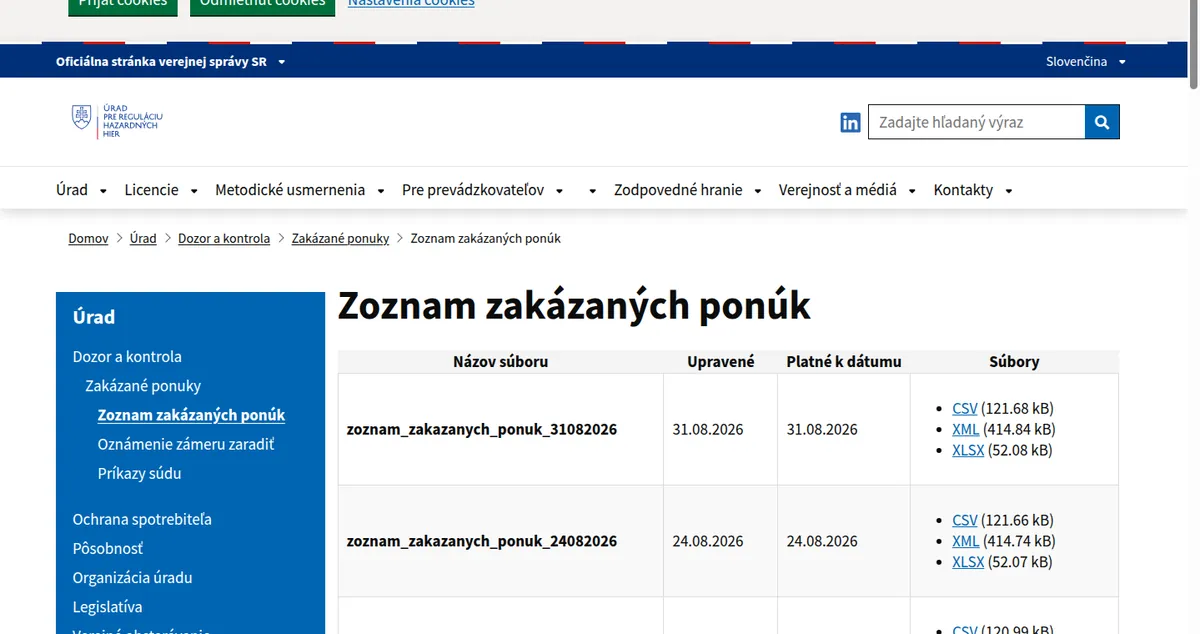
The edition of 31 August 2026 holds 1,120 valid records: 977 web addresses and 143 account numbers. Under § 85(2) the authority publishes it on the first working day of every week, and under paragraph 11 in machine-readable form — CSV, XML and XLSX.
Ten brands without a Slovak licence that we track
Ten brands without a Slovak licence. The columns are copied from the issuer's licence register and from the operator's own terms, as at 26 August 2026. “Not stated” means no such figure appears in the documents we read; it never means zero and it never means unlimited.
- Vave
-
- Amount before documents are asked forcase by case
- LicenceCuraçao Gaming Authority
- Coins90
- Bitcasino.io
-
- Amount before documents are asked for2,500 EUR
- LicenceCuraçao Gaming Authority
- Coins12
- Wild Fortune
-
- Amount before documents are asked forcase by case
- LicenceAnjouan Gaming Board
- Coins10
- Empire.io
-
- Amount before documents are asked for2,000 USDT
- LicenceAnjouan Gaming Board
- Coinsnot read
- Metaspins
-
- Amount before documents are asked forcase by case
- LicenceCuraçao Gaming Authority
- Coins9+
- PlayAmo
-
- Amount before documents are asked forcase by case
- LicenceAnjouan Gaming Board
- Coins7
- Rainbet
-
- Amount before documents are asked forcase by case
- LicenceAnjouan Gaming Board
- Coins9+
- Shuffle
-
- Amount before documents are asked forcase by case
- LicenceCuraçao Gaming Authority
- Coins20
- Wolf.bet
-
- Amount before documents are asked forcase by case
- LicenceGovernment of the Autonomous Island of Anjouan, Union of Comoros
- Coins32
- Bitsler
-
- Amount before documents are asked forcase by case
- LicenceCuraçao no number
- Coinsnot read
 Vave
Vave Bitcasino.io
 Wild Fortune
 Empire.io
 Metaspins
 PlayAmo
 Rainbet
 Shuffle
 Wolf.bet
 Bitsler
Vave je reklamný partner tejto stránky a jediný odkaz, ktorý z nej vedie von. Uvítací balík je rozpísaný na štyri vklady so stropom 4 BTC a 100 roztočeniami — sumy sú uvedené v samotnej ponuke, nie odhadnuté. Licenciu sme si 2. septembra 2026 overili v registri Curaçao Gaming Authority: OGL/2024/1676/0905, držiteľ Latcas B.V., vydaná 19. mája 2025, stav aktívny.
What really decides matters in their terms
Nine of ten carry an identity-verification clause; two give an amount: Bitcasino.io 2,500 EUR in clause 6.6, Empire.io 2,000 USDT in clause 5.4. The other seven carry it with no figure at all, which is a free hand.
Two verify earlier than the phrase promises. For bitcoin deposits Wild Fortune demands a valid document before play in clause 18.1, blocking deposits and bets until verification. Rainbet's AML policy says identity is verified at account opening, and clauses 5.2 and 8.3 name a photograph of the document, proof of address, a selfie or a verification call.
The remaining seven read almost identically: we may request documents if we think it necessary. Metaspins speaks of “a certain threshold” in clause 9.7 and adds no figure. Shuffle in clause 4.1 calls it risk-dependent, at its own discretion. Wolf.bet's help centre adds that verification on large withdrawals is required by law, without saying which or from where.
A threshold not written down can be neither exceeded nor observed. Hence the two published figures are the exception, not the standard: across all hundred brands we track we read a clause with an article number twenty-six times, a monetary threshold in it five times.
The difference between an amount and a free hand is the whole content of the phrase; identity verification sets it out. How much may leave in a week or month is in payout limits.
The ten brands one by one and what sets each apart
Order in this list means nothing; there is no ranking here. Each row says one thing: how that brand differs from the rest in its own documents.
- Vave is the tenth in the table. It publishes no verification threshold, but alone of the ten gives a deadline for documents: fourteen days under clause 8.7. Clause 8.8 sets 50,000 USDT, above which a withdrawal goes in instalments.
- Bitcasino.io alone publishes a verification threshold and a payout cap at once. The lower decides, so 2,500 EUR. Its domain has been on the Slovak register since 1 June 2020.
- Empire.io is the second and last with a published threshold, written in USDT, adding a right to close the account if the data were untrue.
- Wild Fortune cancels the order the whole phrase rests on: it wants the document before play. Its cap of 15,000 EUR a month stands in six currencies side by side.
- PlayAmo has the longest restricted-countries list of the ten, and two caps in one clause, weekly and monthly.
- Metaspins names one licence issuer in its footer; we found another in the register. Two issuers, not two versions of a number.
- Rainbet contradicts itself in two of its own documents about when identity is verified. Its licence number here comes from the register, not its text.
- Shuffle calls its verification threshold risk-dependent, at its own discretion. Its list of fifteen countries is opened by a sentence about any other place.
- Wolf.bet invokes the law without saying which, and its own pages name two different regulators.
- Bitsler opens an account on an e-mail address. Behind its Curaçao number stands an application in the transitional regime, not a licence.
Why we make no ranking of these ten rows, and what can be compared instead, is in best online casino.
Why there are ten names here and not thirty
The ten are no cross-section of the market and we do not pretend so. They are picked from a library of a hundred brands, so that documents could be compared, not offers.
The reading status of that library is this. At thirty-seven brands we opened the documents on their own sites. At another forty-one, archived copies of the same pages, a weaker form of the same: the item holds at the snapshot's date, not today's. At twenty-two nothing could be read and every field stays empty.
Of those seventy-eight, we tied the verification clause to an article twenty-six times, the monetary threshold inside it five times, the payout cap fourteen times, the restricted-countries list thirty-eight times.
Those figures are here on purpose and say two things at once. First, how large a part of the industry publishes its own terms unintelligibly or not at all. Second, how much of what stands here is copied from the text and how much is missing. Thirty names would make this page a longer list with more empty cells, not a better answer.
What we corrected in our own work, and how we record it, is in how we read documents.
Where Slovakia appears on country lists and where it does not
The list of countries an operator refuses players from is the industry's most overlooked document. It is not marketing. It is a contractual term the brand invokes when a payout must leave.
In the wider library we track a hundred brands. We read such a list at thirty-eight; Slovakia stands on eleven. The Czech Republic and Poland come out the same, Germany has twelve, the United Kingdom twenty-nine and the United States thirty-two.
Slovakia is thus not a country the industry overlooks. Six of those eleven run past two hundred items, excluding almost the whole world at once; the other five are short, Slovakia picked out by name.
That is why nine of these names stand in the table above. Not one of the nine lists we read names Slovakia. At the tenth row, our partner, we traced no such document and the cell stays empty; an empty cell here always means “not read”.
Those lists cannot be compared at a glance and we deliberately do not try. Wolf.bet gives its forty-eight countries with the wording “including but not limited to”, so the list is open. Shuffle adds to its fifteen names a sentence about any other place the service is not permitted. Wild Fortune mixes in territories with no country code: Hawaii, Ontario, New Brunswick. What follows at payout is in no-deposit bonus at a foreign casino.
Nine licence numbers and four that do not match the register
Nine of ten publish a licence number: four from Curaçao, five from Anjouan. All nine can be traced in the issuer's register, more than sites offer that mention a licence without a number.
The match between site and register is weaker than expected. At four brands the site carries a different number from the register's.
Metaspins is the sharpest case. Its footer gives an Anjouan number, while the certificate we traced is Curaçaoan. Not two versions of one item, but two different issuers. PlayAmo goes the same way: a Curaçao number on the site, an Anjouan one in the register. Wild Fortune's site has a seven-digit number with nothing in common with the register entry.
The authority's name diverges inside one brand too. Bitcasino.io names one supervisory body in its AML document, another on its help pages. Wolf.bet links to Curaçao in its responsible-gambling section, while footer and terms speak of Anjouan.
The tenth is the advertiser here, and on 2 September 2026 we checked its licence in the Curaçao Gaming Authority certificate register: number OGL/2024/1676/0905, holder Latcas B.V., issued 19 May 2025, status active. We do not count it among the nine: that count is what a brand publishes on its own site, and that we did not read here.
Not one of those numbers says anything about Slovakia. All nine, contradictions included, stand in foreign licences.
What the table above does not measure
Plenty of empty cells, and we do not cover them. Licence number at nine rows of ten, coin count at six, payout cap at three. “Not stated” always means the same: no such item stands in the document we read. Never zero, never no limit.
Nor does it measure speed. We read a withdrawal processing time at one brand of ten, the advertiser: clause 8.1 speaks of three days at most. At the other nine no such item stands in the terms, so there is no sentence here on their speed.
We do not convert currencies. A threshold in USDT stays in USDT: the rate moves, no conversion mechanism stands in the terms, and a conversion would be our estimate, not the operator's promise.
And it does not measure rank. No stars, no league table: they would feign a comparison we cannot make and would cover the very empty cells this site was built for. The one button leading to an operator's commercial interface carries a source-code attribute marking a paid link, which does not touch the rows' figures.
A bonus rule is read not from the amount but from five sentences
Around casinos without a Slovak licence the bonus is searched for above all, almost always by the number. Yet the number is the part of an offer that costs nothing: it takes a second to say, and five sentences sitting elsewhere decide it.
The first is the wagering requirement: how many times and within what period the bonus must be wagered, and whether your own deposit counts. The same amount at ten times and forty times are two entirely different offers.
The second is the cap on winnings from a bonus, usually separate and lower than the ordinary payout cap. The third is the maximum stake during wagering, the fourth the list of excluded games; breaching either usually cancels the winnings, not delays them. The fifth is the reference to the identity-verification clause, which a bonus document usually borrows from the ordinary terms.
That fifth sentence is why the documents clause bites harder on a bonus than on your own money: there was no deposit to want back. The first moment you see a request for a scan is the first moment you stand to lose something.
On the Slovak side a player has one extra figure for wagering, and nobody need promise it. § 32(1) orders a licensed operator to keep on view during play a summary of bets and winnings, cumulative for the calendar month and since the account opened. That is the item wagering is checked against, and outside the Slovak regime it need not be on screen.
Answers to bonus questions are therefore split across four pages, not one paragraph:
- no-deposit bonus: which clause of the terms decides the winnings from it;
- foreign casino no-deposit bonus: what is different about it for a player from Slovakia;
- English casino no-deposit bonus: why it is the most misleading of those phrases;
- registration bonus: how it differs from a no-deposit bonus.
Bonus terms tend to be a separate document at an operator and we opened none. Hence no wagering requirement and no bonus amount stands on these pages, apart from the one Vave sets out below the table.
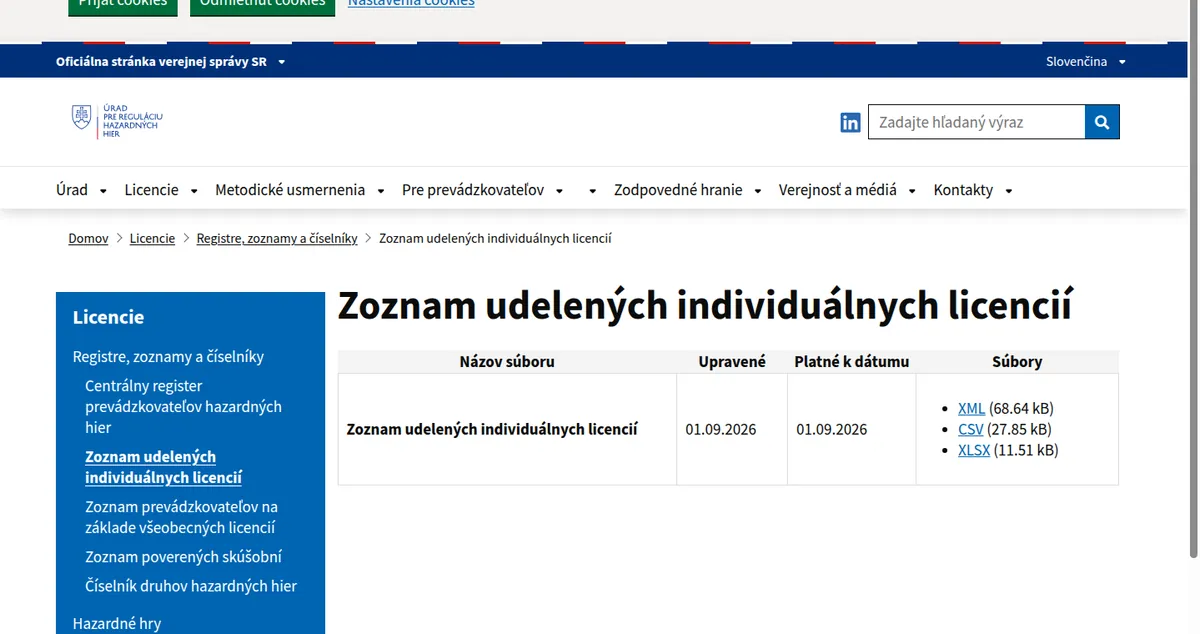
The file as at 1 September 2026 has 134 rows and 39 companies. Twenty-one of them hold a licence to run internet games in an internet casino. It is published in both CSV and XLSX.
What the Vave document says about payouts
Vave is the only link leading out of this site, and it pays for it. Hence its terms are set out more fully than the rest: with a partner the temptation to fill a missing item is greatest, and the only defence is citing article numbers.
The verification clause stands in clause 8.7 and gives no amount: the operator may request documents before any payout at its discretion. That clause then goes further than the other nine: it names a selfie with the document, one with the document and written text, a phone call and a live video call; it asks the document to show name, photograph, date of birth and nationality; it gives fourteen days and, for missing them, states closure of the account and forfeiture of the winnings.
Two further clauses handle the payout. Clause 8.1 speaks of processing within three days at most and splitting a larger request into instalments. Clause 8.8 adds a threshold: above 50,000 USDT the sum is paid in equal instalments over up to thirty days. Whether a deposit must be wagered before withdrawal does not follow from the clauses we read: we did not read the section where such a condition would stand, so we know neither the multiple, nor whether it attaches to deposit, offer or both, nor the time limit and minimum odds.
The loyalty programme has its own arithmetic, summarised nowhere. One point comes from 30 dollars wagered on slots; table and live games do not count; a dollar takes two hundred points. Six thousand dollars wagered thus means one dollar back. The full breakdown, with what we could not trace, is in the Vave review.
Foreign means neither English nor new
Not one of the ten gives a British number, while seven shut Britain out. The relationship is the reverse of what the phrase promises: the brand accepting you as a Slovak tends to be the one that would turn a Briton away.
It is similar with the word “new”. We read a founding year in the terms once, at Bitsler, and at Shuffle the anti-money-laundering document gave the year the company was registered, not the site's launch year. The rest publish no founding date, so “new” here is no property of a brand but an impression from advertising.
Who belongs to the “foreign” group is defined by foreign online casino. What dates a brand's age instead of advertising is shown by new online casino.
Four terms that mean something other than they seem
Most misunderstandings here arise on four words. All four have a precise meaning in the documents, and none of those meanings is what advertising promises.
Licence. In the issuer's register it proves one thing: a certificate with that number exists, is issued to that company and has that status today. It proves no payout, no speed, and says nothing about Slovakia. At one of our ten an application in the transitional regime stands behind the number, not an issued licence.
Anonymity. The verification clause attaches to the account and its holder, not the network the money arrived over. An anonymous payment and an anonymous account are two different things, so a cryptocurrency deposit does not decide the documents question.
Limit. The word alone says nothing until a period stands beside it. Between a weekly cap and a monthly one the same amount means a wait twice as long, and in the fourteen documents where we read a cap the period attaches now to a day, a week, a month, a single transaction.
Entry on the register. No risk ranking, no report card. A domain's absence does not say the brand holds a Slovak licence: seven domains of our ten are not on the register and not one holds a licence.
A player is not a supervised entity
That playing at an unlicensed casino is an administrative offence is repeated often, but no such sentence stands in the act. § 95(1) defines its own circle of persons, a natural person who is a supervised entity under § 80(b) to (k), and a player is not in it. The full wording, with the fines, is in what the law says.
The risk does not vanish, only moves: it is contractual, the money sitting with a company that does not go by Slovak law.
The register of excluded persons ends at the licence border
The register of excluded persons is kept by Úrad pre reguláciu hazardných hier (the Slovak gambling regulator) and created by § 33. Anyone in it may not enter a gaming arcade or casino and may not play online at a licensed operator. Entry is applied for by post or through slovensko.sk with a qualified electronic signature.
An internet-game operator must check that register at every player login. But “must” belongs to the licence, not to a website as such.
A brand without a Slovak licence does not check it, having nothing to check against and nobody to order it to. A self-exclusion set on the licensed side does not reach the other. It is the harshest practical difference between the two sides, with nothing to do with bonuses or payout speed.
The free gambling helpline is 0800 131 000, run by OLÚP Predná Hora, a specialised hospital.
How to check one brand in ten minutes
The whole exercise runs in a browser, before registration, and needs no account and not us.
- Go to the bottom of the brand's site and open the link to the terms. Find the section KYC, AML or Verification and note the article number and whether an amount stands by the clause.
- In the same document find Restricted Countries or Prohibited Territories and look for Slovakia. Watch for wording such as “including but not limited to”: such a list is not closed.
- Find the clause on payouts and in it the cap and its period. Work it against a sum you would call a large win and see whether the answer comes in days or months.
- Open the licence footer and check the number with whoever issued it. Compare three things: company name, authorisation and status. All three must match.
- Download Zoznam zakázaných ponúk, the Slovak register of prohibited offers, and search for the domain, not the name.
If any of those five steps ends without a result, that is a result too. Note it as you would a valid entry.
Where to check it yourself
Three public documents, and you need us for none.
- The ÚRHH register of individual licences says who may run an internet casino here: twenty-one names in who holds a Slovak licence.
- The ÚRHH Zoznam zakázaných ponúk says whether the authority entered that domain. Three of our ten are on it; the list of prohibited offers sets it out.
- The brand's own terms say the rest. Our article numbers come from how we read documents.
The first two files come in CSV and XLSX and download in seconds. The third is longer, but only two are looked for: the section KYC, AML or Verification and the section Restricted Countries. Both tend to sit in the same document, the one the brand's footer links to, readable before registration, not after.
If you cannot find either passage on a brand's site, that in itself is an answer. It is an answer you get free and before you deposit.
You will find no sentence here saying “we tried it”: we hold no account anywhere and have not deposited a euro.