
Why a Slovak casino cannot have quick registration
§ 31 and § 32 word for word
The Slovak act lists four identifying details a player submits when registering for an internet game, and seven pieces of information the operator must show him at every login. The list is not a recommendation, it is a condition of taking part.
Four details without which no account exists
§ 31(1) of zákon č. 30/2019 Z. z. opens with a sentence cancelling the phrase “quick registration” on the Slovak market:
A condition of a player's participation in an internet game is registration and a player account.
It then lists what the player submits: given name, surname and title; birth number, or date of birth where none is assigned; permanent residence or residence permit; nationality.
A birth number and a permanent residence are not details you invent when opening an account. They come from a document, so § 33(1) adds the operator's duty to require details from an identity card and a further document, copies of which the applicant sends in. That section is analysed on what the law says.
Two further subsections of § 31 are less known and worth reading. Subsection 2 says a player may hold only one player account with one operator. Subsection 3 says that after an account is closed the operator must return the player's balance. How fast an account arises at foreign brands, and when documents arrive, is separate: registration at casinos without verification.
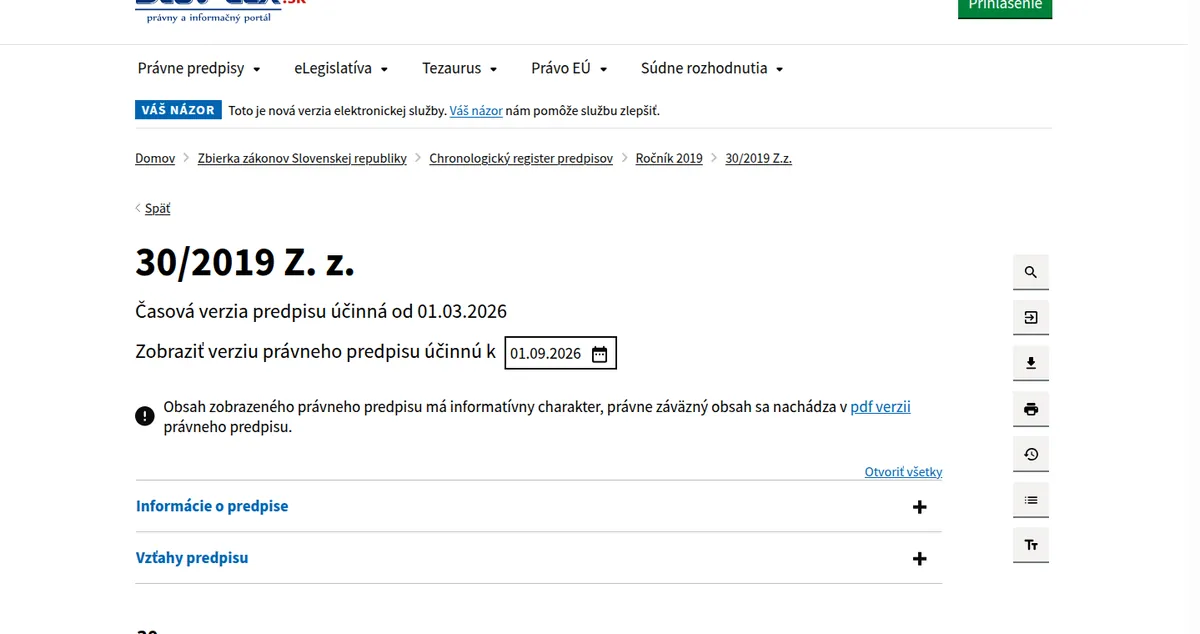
Every citation of § 31, § 33, § 36, § 80, § 85 and § 95 on this page comes from the version of the act in force from 1 January 2026. The English translation the authority itself offers is the version of 1 June 2019, and its numbering of the paragraphs of § 85 already differs.
Seven things on the screen at every login
§ 32(1) requires the operator of an internet game to display seven items in a visible place throughout play:
- the sentence “Gambling is prohibited to persons under 18”,
- information on the health risks of excessive play,
- a warning reading “Gambling carries the risk of high financial losses”,
- a summary of the player's stakes and wins, cumulative for the calendar month and since account opening,
- a telephone number or link to a specialised medical institution,
- a link to the register of excluded persons' administrator,
- information on the option of a self-limiting measure.
Read the list as an interface description. All of it must be on a Slovak licensed casino's screen, like it or not.
The fourth item is the most practical of the seven and the least discussed. A summary of stakes and wins, cumulative for the month and since account opening, is the only figure by which you can check a bonus wagering condition without your own table. Outside the Slovak regime nobody must show it; what that means for a bonus is taken apart by no-deposit bonus.
The sixth and seventh items point to one place: the register of excluded persons. The regulator keeps it under § 33, a person enters himself by post or electronically through slovensko.sk with a qualified electronic signature, and only a Slovak-licensed operator must check it at every login. The detail is in what the law says.
Why those four cannot be filled in from memory
A form you click through in a minute asks for an e-mail and a password. The enumeration in § 31 is another class of detail, and there lies the difference.
Given name and surname can be typed in. A birth number, permanent residence and nationality, though, are details written down somewhere, and the operator must compare them with a document. Hence § 33(1) speaks of copies the applicant sends in, not of fields he fills.
From this follows a sequence many realise only at the first withdrawal. On the Slovak side a document conditions the first bet. On the other side, the first payout. The same requirement, two moments, and the difference is paid by the player in his own time and money.
The act adds one more consequence, rarely mentioned. The details from § 31 also serve to check age and the register of excluded persons. Neither check can be made without them, so a licensed operator needs them before it lets anyone play.
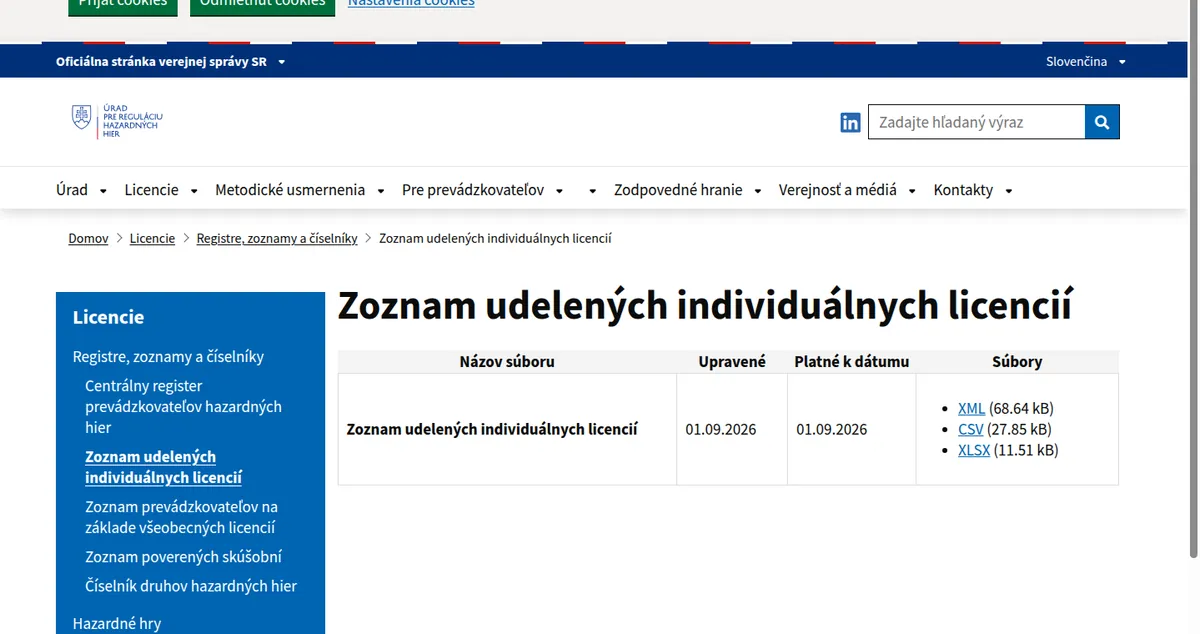
The file as at 1 September 2026 has 134 rows and 39 companies. Twenty-one of them hold a licence to run internet games in an internet casino. It is published in both CSV and XLSX.
What of this applies at a foreign brand
None of it. § 31 and § 32 are obligations tied to a Slovak individual licence, and none of the ten brands in our table holds one. Who does is listed by who holds a Slovak licence.
That does not mean those brands want nothing. It means they set the scope themselves in their terms, and that is where one reads. What we found there about documents is in identity verification.
Where our data ends
The question “how many details do they ask at account opening” differs from “when will they ask for documents”, and only a third of the nine documents answers it.
- Bitsler, clause 4.3: an e-mail is enough to open an account. It may, though, ask for proof of age or identity at any time, to verify details entered at registration.
- Rainbet: the terms tie verification to withdrawal, in clauses 5.2 and 8.3, while its own AML document says identity is verified at account opening. Two documents, two moments.
- Wild Fortune, clause 18.1: a player depositing in bitcoin must submit a valid document before play and has deposits and bets blocked until verification.
The six remaining documents say nothing of the moment of registration, so an empty cell stays with them in the table. We opened no registration forms: we hold an account with no operator and will not open one to describe how it looks.
An empty cell is content, not an excuse. It means “we did not read it”, never “they do not ask”. How we handle such places is in how we read documents.
What those three sentences mean for the phrase “quick registration” is worth attention. One brand of nine cancels it entirely for one deposit method, a second contradicts itself, a third keeps it but with the right to ask for a document at any time. In no case a promise, only an order of events.
One thing quick registration does not change
Whether an account arises in a minute or a day, money enters and leaves it by rules the operator wrote itself. At the leaving the two topics meet, and there it is decided whether quick registration was an advantage or a postponement. The numbers operators publish are in payout limits.