
A file you can download, and the obligations that follow from it
Direct answer
The edition at 31 August 2026 has 1,120 valid entries: 977 web addresses and 143 account numbers. It comes in CSV, XML and XLSX and anyone can open it. The obligations arising from it fall on network operators, on banks and on app stores — not on the player.
What is in that file
The list is kept by Úrad pre reguláciu hazardných hier under § 85 of zákon č. 30/2019 Z. z. Under subsection 2 it is published on the first working day of every week, at the previous week's last day; under subsection 11, in machine-readable form. Hence three formats side by side and an archive of older editions.
We downloaded the edition dated 31 August 2026. It has 1,124 rows, of which 1,120 carry no deletion date: 977 web addresses and 143 account numbers, each with an IBAN and a BIC.
The reason for entry stands on every row as a reference to § 85(4). Letter a) means running an internet game without an individual licence and stands at 774 entries. Letter b) means promoting such a game or enabling access to it and stands at 346 entries. Almost a third of the list is not about casinos, then, but about the routes to them.
The oldest valid entries carry the date 17 July 2017 and belong to bet365 and williamhill.com. In 2026 the list took on 130 entries. The date-of-entry column is the only public way to date a foreign domain, and it is used by new online casino.
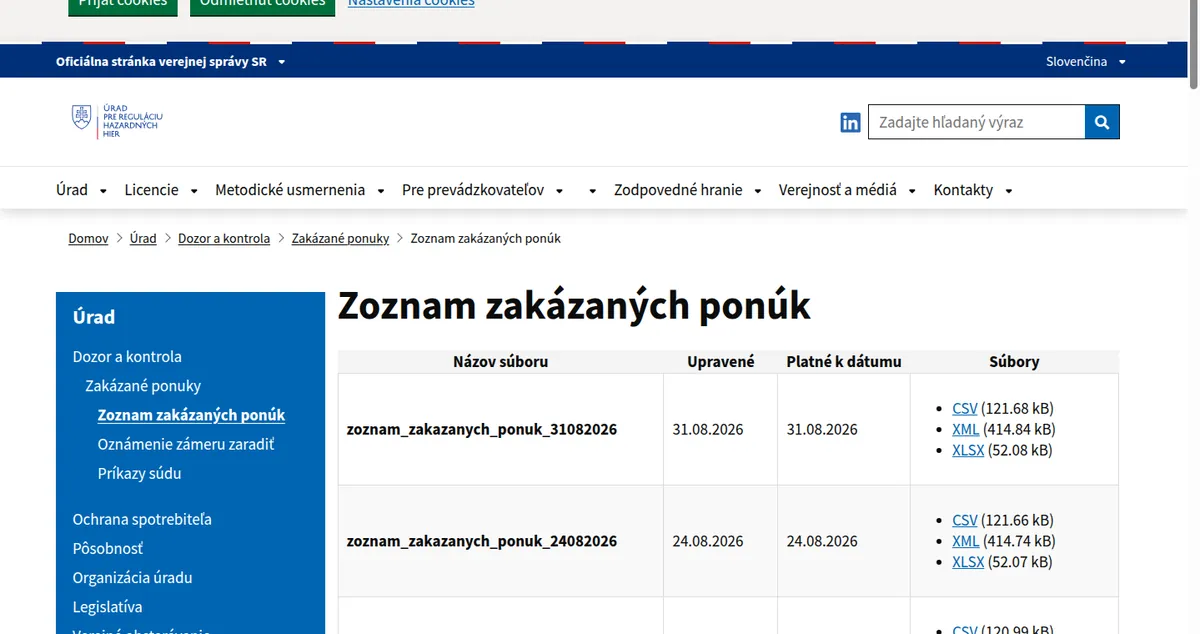
The edition of 31 August 2026 holds 1,120 valid records: 977 web addresses and 143 account numbers. Under § 85(2) the authority publishes it on the first working day of every week, and under paragraph 11 in machine-readable form — CSV, XML and XLSX.
How a domain is found in that file
It is not a database with a search box but a table for download, searched like any other.
- Download the current edition. Of the three formats XLSX is handiest for an ordinary search; CSV suits comparing two editions by script.
- Search for the domain, not the brand name. The file holds web addresses, and a brand may be called something other than the site you play on.
- Look at the deletion-date column. A row with a date filled in is struck out and no longer applies; our copy had four such rows.
- Check the reason for entry. A reference to § 85(4)(a) means running without a licence, letter b) promotion or enabling access.
The archive of older editions is on the same page. It is the only way to find when an address got onto the list, if the development interests you, not the state.
Whom an entry binds
§ 85(12) describes no technique, it describes the addressee:
A person providing electronic communications networks and services is obliged, on the basis of the list of prohibited offers, to prevent access to a website entered on the list and through which a prohibited offer is provided.
The second sentence of the same subsection does the same with money: a payment service provider is to prevent payment in favour of an entered account used to receive deposits. Hence account numbers beside domains in the file — not a curiosity, an instruction to the bank.
The third branch is subsection 13, aimed at app stores: an application whose name and identifier are on the list is to be withdrawn from the offering within five days of the list's publication or update. The identifier is, under § 85(3)(b), the checksum of the executable file or another unique designation, so renaming will not get round it.
For non-compliance the one whose obligation it is pays. § 80(k) counts among supervised entities “other entities to the extent of their obligations under § 85(12) and (13)”, and § 95(1)(g) makes that an offence fined from €10,000 to €100,000. The player is not in that enumeration, as what the law says shows.
How a domain gets onto the list
Entry is not immediate and § 85(7) sets the exact sequence. The regulator first publishes a notice of intent and e-mails the operator a call to end provision within ten days. If the page gives no electronic address, it may enter the domain without a call, but at the earliest ten days after the notice.
Under subsection 8 the person concerned may object within ten days. Under subsection 9 a site is not entered, or is struck out, if the supervised entity proves it provides no prohibited offer or has ended it.
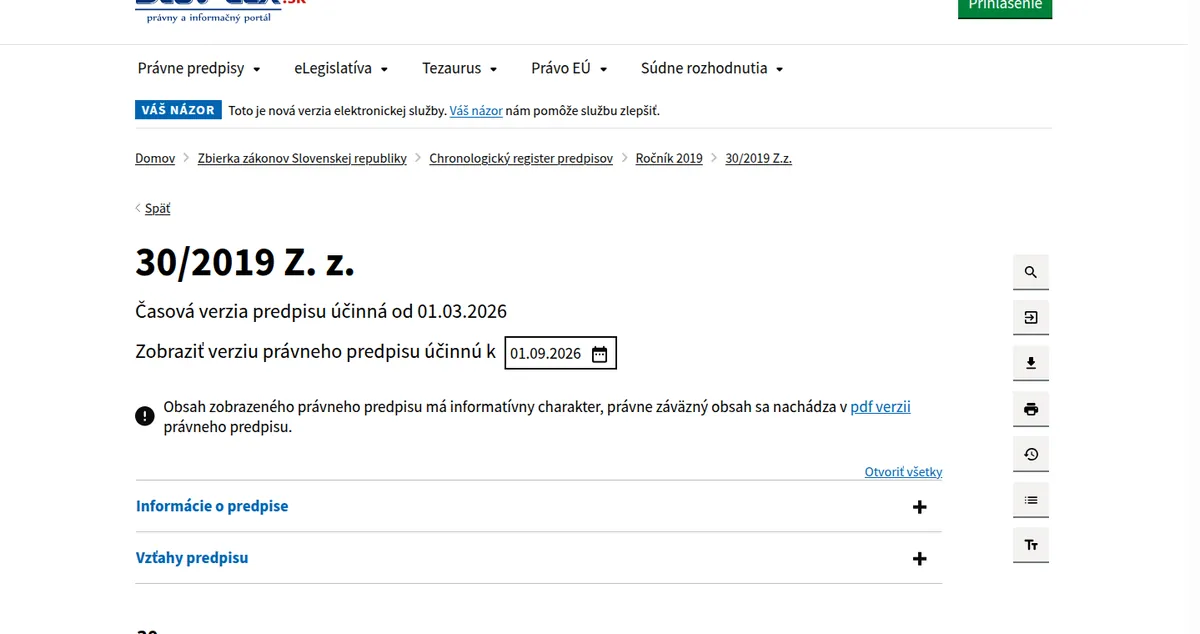
Every citation of § 31, § 33, § 36, § 80, § 85 and § 95 on this page comes from the version of the act in force from 1 January 2026. The English translation the authority itself offers is the version of 1 June 2019, and its numbering of the paragraphs of § 85 already differs.
Three brands of our ten stand on it
We compared our table's domains with this file.
- bitcasino.io entered since 1 June 2020, reason § 85(4)(a).
- playamo.com entered since 2 March 2020, same reason.
- rainbet.com entered since 16 June 2025, same reason.
The seven remaining domains are not on the list. That does not mean they hold a Slovak licence: none of the ten does, and who does is written out in who holds a Slovak licence.
At every address stands the provider name the regulator established at entry, which need not match today. At rainbet.com it is RBGAMING N.V., the same on the list and in the brand's terms. At bitcasino.io the list gives mBet Solutions NV. and mProcessing Solutions Ltd, while today's terms name Moon Technologies B.V.; at playamo.com the list has DAMA N.V. and Friolion Limited, the terms Novatrix SRL. Both entries are from 2020. So if you are after whom you contract with, the newer applies — and why that matters with a licence number is taken apart by foreign licences.
What an entry does not prove
The list reads easily as a ranking of risk and is not one. Two things in it correct that impression.
First: absence from the list is no certificate. Seven domains of our ten are not on it, yet none of them holds a Slovak licence. An entry says what the regulator has got to, not what exists. Who really holds a licence is written out in who holds a Slovak licence.
Second: presence on the list says nothing about size or age. The oldest valid entries belong to two brands nobody in the industry calls marginal, and have stood there since 2017. The date of entry is the order the regulator acted in.
And a third thing the list does not say at all: nothing about terms. The verification threshold and the payout cap stay after an entry exactly as before, because they sit in the operator's document, not the regulator's.
What an entry changes for you
Directly nothing that would touch you as an offence. Indirectly two things: the route to the page and the route to the money. The second is why payout limits are worth reading before a first withdrawal, not after.