
The word “new” means something different on each side of the market
Two files with dates
The list of prohibited offers took on one hundred and thirty entries in 2026, and the oldest valid ones in it carry the date 17 July 2017. The list of granted individual licences has 134 rows and on each of them a period of validity from and to. A new online casino can therefore be dated in Slovakia from two public files, without taking anyone's word for it.
Two kinds of newness with one name
Looking for a new online casino in Slovakia, you get two unrelated things mixed together.
The first is a new licence: a company added to the Úrad pre reguláciu hazardných hier register, free from now on to run an internet casino here. The second is a new brand: a site that appeared somewhere in the world and takes Slovak players too. The first is an event dated in an official file. The second usually has none.
The difference between the sides is taken apart by foreign online casino.
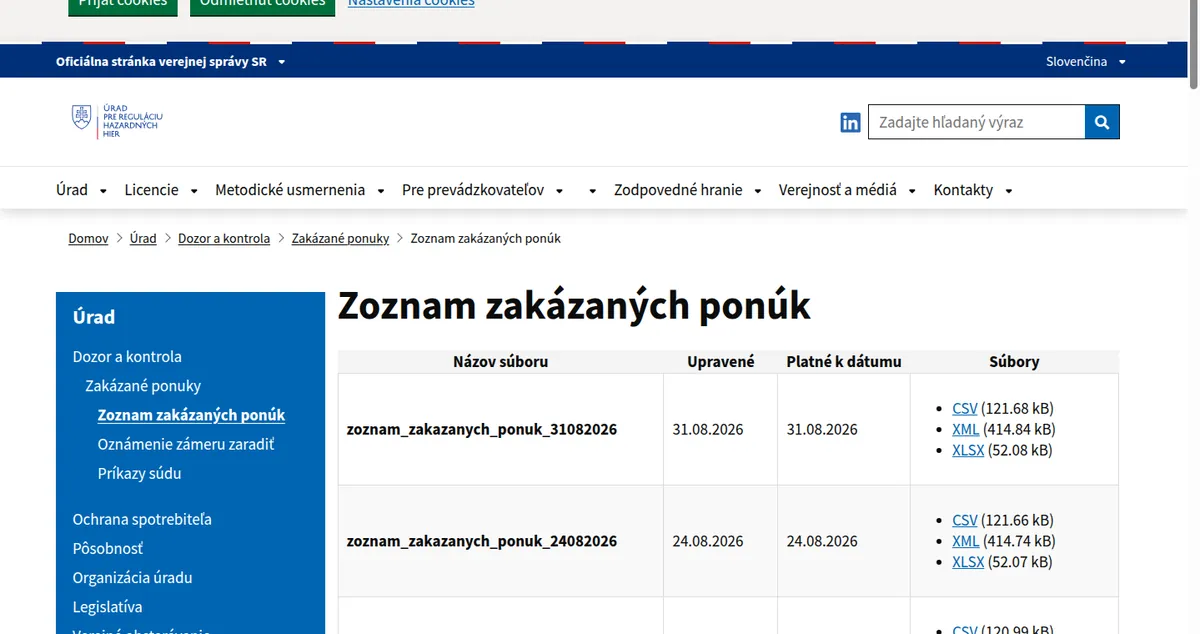
The edition of 31 August 2026 holds 1,120 valid records: 977 web addresses and 143 account numbers. Under § 85(2) the authority publishes it on the first working day of every week, and under paragraph 11 in machine-readable form — CSV, XML and XLSX.
A new Slovak-licensed casino has a row and a date
The register of granted individual licences is a CSV and XLSX file anyone can download. The version from 1 September 2026 has 134 rows and 39 companies. Twenty-one hold a licence to run internet games in an internet casino, and all twenty-one names are written out in who holds a Slovak licence.
Each row gives the company name, IČO, validity from and to, the gambling game's name, code and type. That “from” is the date you want: it says from when that company may run the given game type. A new casino on the Slovak side is not opinion but a row with a start of validity. At foreign brands the register's date of entry replaces the word new: casinos without a Slovak licence by register.
The check is dull and reliable: download the current edition, compare with an older one; the difference is the new arrivals. The register gives no web addresses, only company names, so matching brand to firm is yours.
A new foreign brand rarely publishes a founding date
We read the terms of our table's ten brands on 26 August 2026 and found a year of founding once: Bitsler states 2015. At the other nine the field is empty, meaning we found no such detail in the documents, not that the brand is recent.
We found one more year, but not about a brand. Shuffle's anti-money-laundering document gives the year the company Natural Nine B.V. was founded. A firm's founding and a site's launch are two different things, so we did not write it into the brand's age field.
The licence number's year is not the founding year
A licence number draws attention because a year really does sit in it. The Curaçao numbers of our four start with OGL and continue with a year: one 2023, three 2024. The Anjouan numbers of the other five carry a numeric block with a guessable year too.
Guessed at, yes; read, no. The register does not explain what that year marks: first issue, renewal, a move to a new issuer, or file order. So we do not derive a brand's age from it, and advise you not to.
The same caution applies to Bitsler from the other end. Its Curaçao number is an application's state under the transitional regime, not an issued licence, so its year cannot mark anything like a site's founding date. What follows from it and what does not is set out by foreign licences.
One public date exists, though not about founding. The list of prohibited offers gives the day of entry at every address. Three of our ten are entered: bitcasino.io since 1 June 2020, playamo.com since 2 March 2020 and rainbet.com since 16 June 2025. It says when the regulator entered the domain, not when the brand began, but serves well as the site's latest possible existence point. How to search it is shown by the list of prohibited offers.
The pace of new addresses shows in a single number. In 2026 the list took on 130 entries, while the oldest valid ones are from 17 July 2017. It is updated on the first working day of each week.
Those oldest entries say the most about the word “new”. They belong to two brands nobody in the industry calls new, and have stood there since 2017. Entry is therefore neither a ranking of newness nor of risk: it is the order in which the regulator reached the addresses.
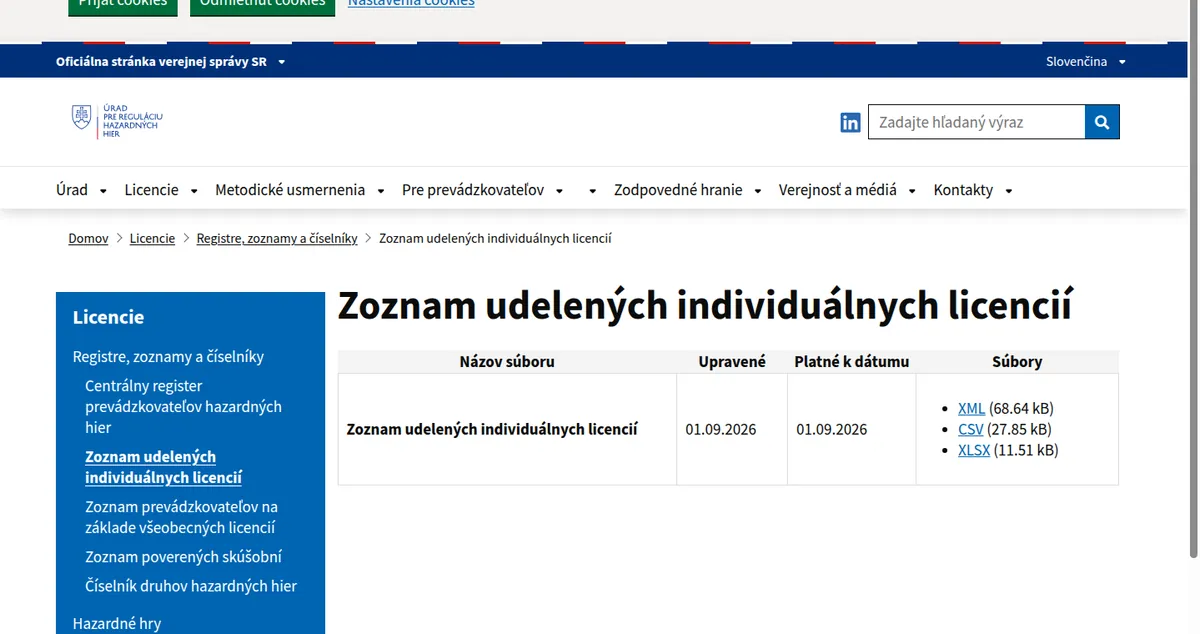
The file as at 1 September 2026 has 134 rows and 39 companies. Twenty-one of them hold a licence to run internet games in an internet casino. It is published in both CSV and XLSX.
A new brand versus a new address
At foreign sites the word “new” gets used where there is no new operation, only a new domain of the same one. We do not claim that happens at any brand, but two public details tell such a case apart.
The first is the company name. The list of prohibited offers gives it at every address as at entry, and at two of our three entered domains it no longer matches today's terms. The second is the licence number: at four of nine the site's number diverges from the issuer's register.
Neither difference is proof of anything by itself. But both are public, both can be checked in minutes, and both say more about an operation's age than the word “new” in a headline.
“New” is not a property worth looking for
A new brand has no worse terms than an old one. It has a shorter trail, the only practical difference: fewer documents to look at, no history in the register.
So instead of age, look at four things a brand launched last month has too:
- The licence number in the issuer's register. What it proves and what not: foreign licences.
- The restricted country list. A contractual condition the operator will invoke at payout.
- The identity verification clause and its number, set out in identity verification.
- The payout cap, set out in payout limits.
At new brands the bonus is the loudest part of the offer and the one we know least about; why, is in no-deposit bonus.
Where to check it yourself
No list of new Slovak online casinos hangs anywhere, but you can make one in minutes: download the current licence register from the ÚRHH site, compare it with an older one, and the difference is exactly the rows added.
At a foreign brand that does not work, and nothing better than the date of entry in the list of prohibited offers exists. An empty “year of founding” field means “we did not read it”, never “recent”; how we handle that is in how we read documents.